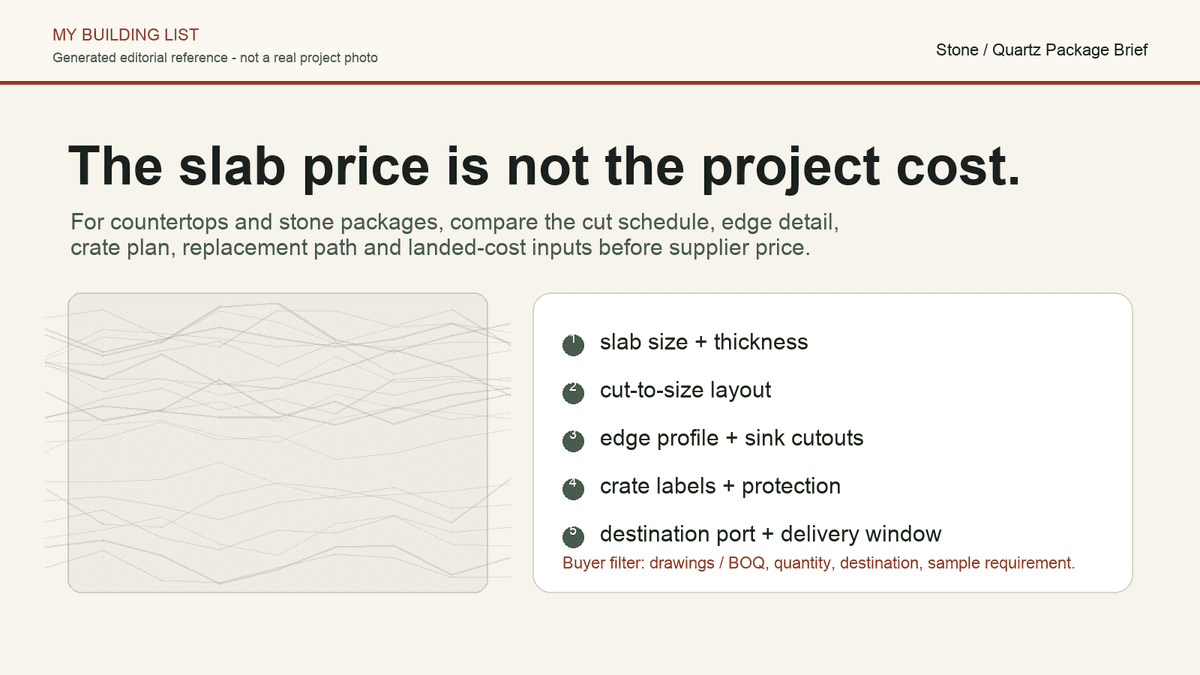
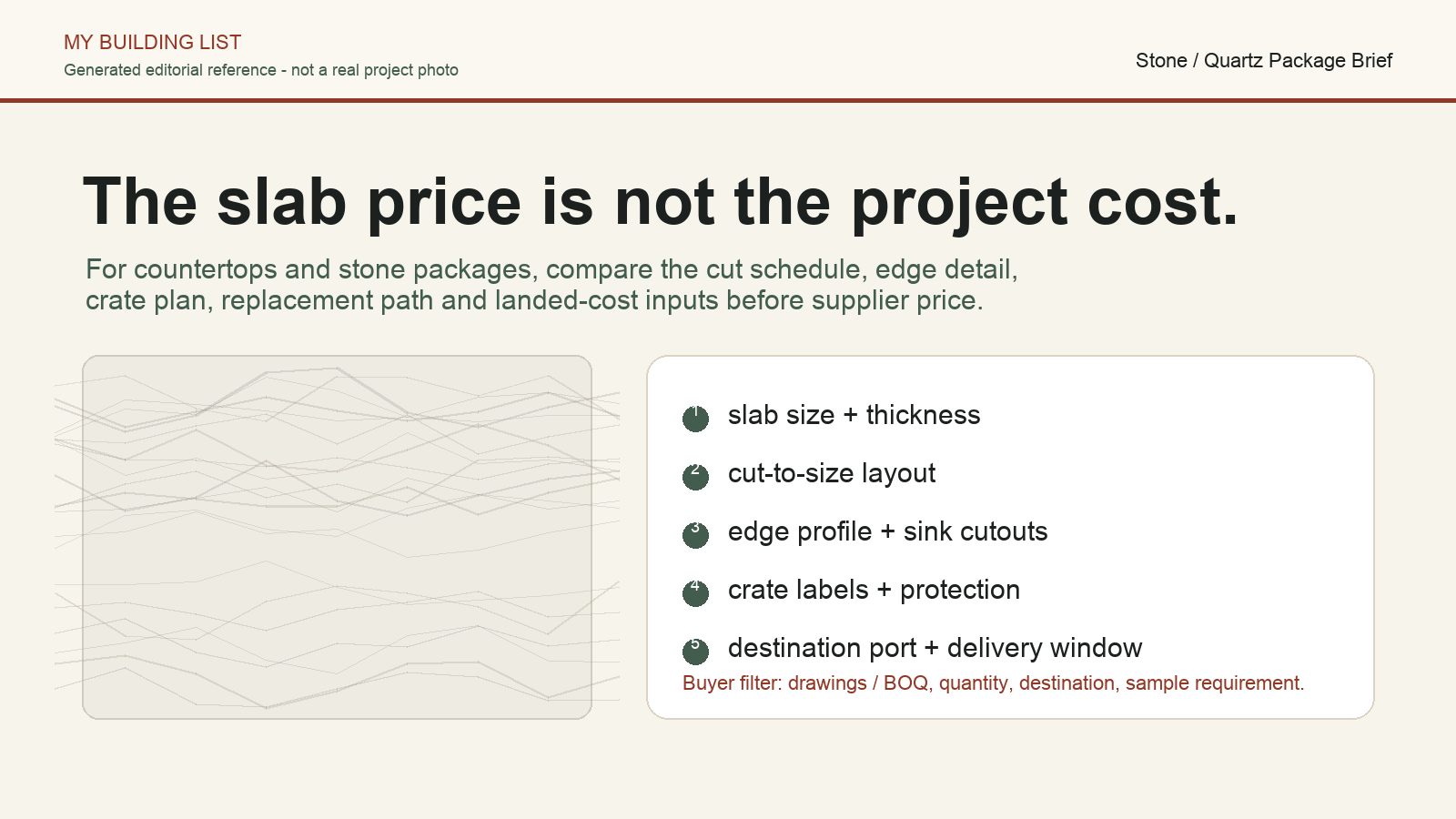
Direct answer: stone and quartz countertop quotes are only useful when suppliers are pricing the same package. A slab price or square-meter price is not enough. Project buyers need to check slab size, thickness, usable yield, cut-to-size layout, edge profile, cutouts, wastage, crate method, replacement handling, freight basis, sample control and destination inputs before choosing the lowest supplier price.
If those inputs are missing, two China stone suppliers can send prices that look comparable but describe different scopes. The lower number may still be valid, but it should win only after the buyer can see what is included, what is excluded and how the finished pieces will reach the project.
Who this guide is for
This guide is for developers, contractors, designers, procurement teams, hospitality buyers, apartment project teams, commercial fitout teams and importers comparing China sourcing options for stone, quartz or engineered-stone countertop packages.
It is not written for one small benchtop replacement or an urgent local retail purchase. China sourcing usually makes more sense when the order has project scale, repeatable units, clear drawings, time for sample review and enough volume to justify packing and shipment coordination.
Why countertop quotes are easy to misread
Countertop pricing can look simple because buyers often see one headline number: a slab price, a square-meter price or a finished-piece estimate. At project level, that number can hide many assumptions.
Common quote gaps include:
- slab size and usable yield
- stone, quartz, sintered stone or engineered-stone specification
- thickness, backing and reinforcement assumptions
- surface finish, color range and vein direction
- cut-to-size schedule and nesting layout
- edge profile and exposed-edge locations
- sink, hob, tap and outlet cutouts
- splashback, upstand or waterfall return details
- wastage allowance and spare-piece plan
- crate method, labels and edge protection
- replacement path if a piece is damaged or missing
- freight basis and destination handling assumptions
A quote that looks cheap may simply be missing a cost or control point. A quote that looks higher may include cut-to-size work, stronger crate protection, clearer labeling or a more realistic replacement plan. Price comparison is useful only after the scope is visible.
What to prepare before asking for prices
Before requesting supplier pricing, prepare a countertop brief. It does not need to be perfect at the first conversation, but it should make the important assumptions visible.
Useful inputs include:
- project type: apartment, hotel, townhouse, villa, retail, hospitality or commercial fitout
- product category: natural stone, quartz, sintered stone or other surface material
- slab size and thickness target, if known
- drawings, countertop schedule or dimensioned sketches
- room count, unit count or estimated quantity
- edge profile and exposed-edge locations
- sink, hob, tap and outlet cutout requirements
- splashback, upstand or waterfall return requirements
- finish direction, reference image or sample preference
- destination country or port
- sample requirement and desired delivery window
If drawings are still early, ask for budget guidance rather than final supplier comparison. Early pricing can help scope a project, but it should not be treated as a supplier decision.
Slab yield is where many comparisons break
Slab yield means how much usable finished work can be cut from the selected slabs. This is where countertop quotes often become misleading.
Two suppliers can quote the same material but make different assumptions about how many slabs are needed, how pieces are nested, whether vein direction must align, how much waste is allowed, whether spare pieces are included and whether oversized islands or waterfall returns need special handling.
For project buyers, the cut schedule should be reviewed before the price is treated as final. The practical question is not only "what is the slab price?" The better question is: "what finished package is this supplier pricing?"
Supplier selection criteria
For countertop packages, buyers should evaluate more than the product photo. Useful supplier checks include:
- experience with project-scale stone or quartz packages
- ability to review drawings and raise clarification questions
- sample and finish-control process
- cut-to-size and fabrication capability
- ability to label pieces by unit, room or area
- crate protection for edges, corners and finished faces
- pre-shipment photo scope
- packing-list clarity
- communication around replacement pieces and revisions
- realistic lead time for samples, production, packing and shipment
A supplier that asks detailed questions before quoting may feel slower at first. That can be useful work if it prevents the buyer from comparing incomplete prices.
Sample confirmation
A countertop sample is not only a design detail. It is a procurement control point.
For a project order, the sample record should connect to:
- material name or code
- finish and surface direction
- thickness assumption
- approved reference photo or physical sample
- quote revision
- cut schedule or room schedule where relevant
- production checklist
The important question is simple: can the approved sample be traced back to the quote and production brief? If not, the buyer may have a nice-looking sample but weak control over what will be produced.
Landed-cost factors
Countertop packages should be reviewed alongside landed-cost inputs, not factory price alone. This is the same reason a building material quote comparison should start with scope, and why landed cost matters more than a factory unit price.
Project buyers should check:
- slab and cut-piece packing volume
- crate quantity and crate weight
- inland transport assumptions
- export handling and freight basis
- destination duties and taxes
- local unloading and storage needs
- site access and damage handling
- replacement-piece timing
Indicative only: landed cost depends on specification, order volume, trade terms, destination duties or taxes, freight and last-mile delivery.
QC and packing checks
Before shipment, define the evidence you want to see. For stone and quartz, the inspection scope should be more specific than "standard QC".
Useful checks include:
- sample or finish reference
- dimensions for key pieces
- visible edge profile
- cutout positions where relevant
- piece labels by unit, room or area
- crate labels and packing list
- corner and face protection
- crate condition before loading
- photos before shipment release
For multi-unit projects, labeling is not a small detail. It affects receiving, site sorting, installation sequence and replacement handling.
Documentation and destination-market review
My Building List does not replace local professional review. Buyers should confirm destination-market requirements with relevant local professionals, especially where materials, installation methods or documents need project-specific review.
The sourcing brief can make supplier inputs clearer:
- product category
- material and finish assumptions
- drawings and quantities
- packing list
- commercial invoice and export documentation inputs
- delivery terms and destination details
- sample and pre-shipment evidence
Clear inputs make local review and project coordination easier.
When China sourcing makes sense
China sourcing may make sense when:
- the countertop order is project-scale
- drawings or schedules are available
- the buyer can review samples before production
- the project has enough time for clarification and shipment
- the package includes repeatable units or multiple material categories
- the buyer can provide destination and quantity information
It may not make sense when:
- the order is one small replacement top
- the timeline is too urgent for sample review and freight
- dimensions, quantity and destination are unknown
- the buyer only wants the lowest retail number
- local installation constraints are still unclear
How My Building List helps
My Building List helps project buyers turn drawings, schedules and finish direction into clearer sourcing briefs before supplier comparison. That can include countertop packages, custom cabinetry, bathroom packages, tiles, fixtures and other building material categories where samples, documentation, QC and landed-cost assumptions matter.
For a stone, quartz or countertop package, send:
- product category and project type
- drawings, countertop schedule or BOQ if available
- slab size, thickness or finish direction
- edge and cutout requirements
- estimated quantity or room count
- destination country or port
- sample requirement
- delivery window
Send your countertop brief when the project has enough detail for supplier comparison.
FAQ
Why are two quartz countertop quotes different?
They may be based on different slab sizes, thicknesses, cut schedules, edge details, cutouts, wastage, crate methods, freight basis or replacement assumptions. The price is not comparable until those inputs are visible.
What should I send before asking for countertop pricing?
Send drawings or a countertop schedule, material direction, slab size or thickness target, edge profile, cutout requirements, estimated quantity, destination country or port, sample need and delivery window.
Is slab price the same as project cost?
No. Slab price is only one input. Project cost can also be affected by yield, fabrication, wastage, packing, freight, destination handling and replacement pieces.
Should I request a sample before ordering?
For project orders, sample review is strongly recommended. The sample should connect back to the quote, finish direction and production brief.
Why does packing matter for stone and quartz?
Countertop pieces can be heavy and edge-sensitive. Crates, labels, corner protection and loading photos help reduce receiving and sorting problems.
Is China sourcing suitable for one countertop?
Often no. One small countertop or urgent replacement may not justify sample time, packing coordination, freight and import handling.
Can My Building List check local project requirements?
My Building List can organize supplier information and documentation inputs. Destination-market requirements should be reviewed by the buyer and relevant local professionals.
How to Compare a Stone Countertop Supplier in China
A stone countertop supplier in China should price the same drawing package, material reference, thickness, edge profile, cut-outs, backsplash, finish and packing basis. A slab price and a fabricated-piece price answer different questions and should not be compared directly.
Turn Slab Yield Into a Buyer-Controlled Input
Ask for the proposed cutting layout, usable slab assumptions and wastage treatment. For patterned material, confirm vein direction, book-matching expectations and how replacement pieces will be matched. Approve the physical sample and, where practical, representative slab images before cutting.
QC and Crate Identification
Check finished dimensions, cut-outs, edge details, surface defects, piece codes and crate protection. Crate and piece labels should match the installation schedule so the site team can locate each item without opening every package.
What should be sent with a countertop RFQ?
Send plans, elevations, cut schedules, material references, thickness, edge and cut-out details, quantities, destination and installation sequence. Submit the package for supplier comparison.